Offside Is About the Moment of the Pass
Understand soccer offside by separating a player’s position at a teammate’s touch from later involvement, making close calls easier to read.
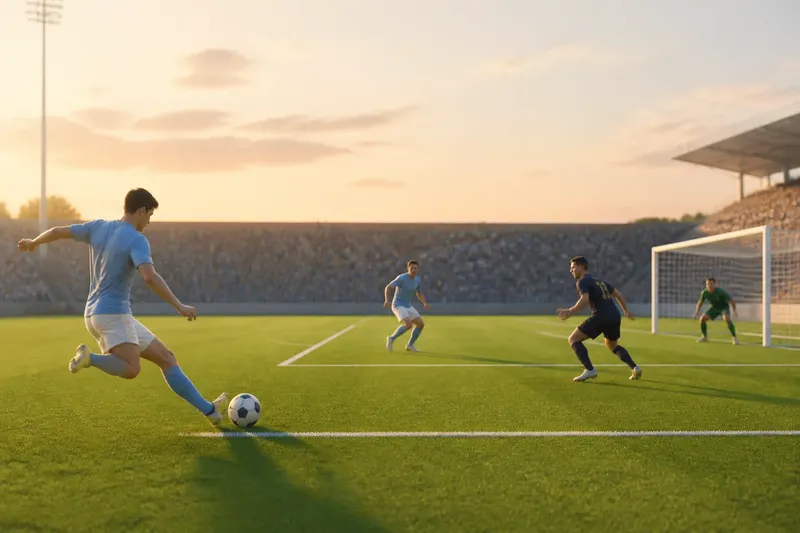
A forward waits near the penalty area as a teammate shapes to pass. The defender steps up, the ball leaves the passer’s foot, and the flag rises only after the forward touches it. To understand soccer offside, freeze the action at the instant the teammate plays or touches the ball—not when the receiver gets it. That moment sets the position test; what happens next helps determine whether an offense occurs.
Offside is not simply a race between an attacker and the last defender. The rule separates a player’s location from that player’s involvement in play, then asks whether the player gained an advantage by being there. Keep those questions apart and even a close run becomes easier to follow.
Soccer offside starts with the teammate’s touch
A player is in an offside position if, at the relevant moment, part of the head, body, or feet is in the opponents’ half and nearer to the opponents’ goal line than both the ball and the second-last opponent. The halfway line itself is not part of the opponents’ half. Hands and arms do not count for any player, including the goalkeeper.
The comparison is with the second-last opponent, not automatically with the goalkeeper or the nearest defender. A goalkeeper may be off the goal line, while another opponent is deeper. The referee or assistant referee judges the eligible body parts against the ball and the second-last opponent when a teammate plays or touches the ball.
A teammate’s touch can set the timing even if the ball is deflected or mishit. The relevant moment is not when the receiver controls the ball, nor when a defender turns to chase. The later action matters for involvement, but it does not move the original position snapshot.
An offside position becomes an offense only through involvement
Standing in an offside position is not itself an offense. A player may remain there without being penalized if that player does not become involved in active play. This is why officials can wait to see what happens before signaling.
Involvement can mean playing or touching the ball, interfering with an opponent, or gaining an advantage from a rebound, deflection, or deliberate save. Interfering with an opponent can include blocking the opponent’s line of vision, challenging for the ball, or making an action that clearly affects the opponent’s ability to play it.
The player need not touch the ball. Imagine a forward in an offside position runs across a defender’s view as a teammate shoots. If the forward obstructs the defender’s sight of the ball and affects the defender’s attempt to play it, the forward may be penalized. If the forward stays clear and does not affect an opponent, the position alone does not settle the call.
Use the snapshot first, then judge what the player does
For a close call, identify the teammate’s contact with the ball. At that instant, compare the attacker’s eligible body parts with the ball and the second-last opponent. Then follow the play to see whether the attacker touches the ball, challenges an opponent, obstructs play, or otherwise becomes involved.
Say you are watching a match and an attacker begins a run behind a defender. At the teammate’s touch, the attacker’s foot is level with the second-last opponent. The attacker is not in an offside position, so if the attacker later receives the pass, that position test does not produce an offside offense. If the foot is beyond the opponent toward the goal line at that same instant, the attacker is in an offside position; a penalty still depends on later involvement.
The defender’s line can give a misleading picture
“Behind the defense” is too loose to decide offside. The relevant comparison is with the second-last opponent and the ball, measured at the teammate’s touch—not with a line drawn across the whole defensive unit.
A defender’s movement after the pass cannot retroactively change the attacker’s position. But a defender who has fallen or moved toward the goal line may be the second-last opponent at the decisive instant. Judge the positions at that moment, not the scene that develops afterward.
Being level is allowed. If the attacker’s eligible body parts are level with the second-last opponent or the ball, the attacker is not in an offside position. A distant viewing angle can make a level run look slightly ahead.
How do rebounds, defender touches, and restarts affect offside?
Can a player be offside from a rebound?
A player who was in an offside position when a teammate played the ball can be penalized for gaining an advantage from a rebound off an opponent or from a deliberate save. The rebound does not create a new position snapshot for that attacking play. A deliberate save is treated differently from an opponent deliberately playing the ball.
Does a defender’s touch always reset offside?
No. An opponent’s deliberate play can make an attacker who was in an offside position eligible to receive the ball, unless the opponent was making a deliberate save. A mere deflection or rebound does not have that effect. Whether the action counts as a deliberate play depends on the circumstances, including whether the opponent had control and deliberately played the ball; a touch alone does not settle it.
Can a player be offside directly from a throw-in?
No. A player cannot be penalized for an offside offense when receiving the ball directly from a goal kick, throw-in, or corner kick. If a teammate touches the ball afterward, the normal position and involvement tests apply to that new touch.
Choose a useful view of the play
For a fast run, start with the snapshot: find the teammate’s touch, the halfway line, the ball, and the second-last opponent. For a loose ball or a player who stays away from the first touch, follow involvement: ask whether that player later touches the ball, challenges an opponent, obstructs play, or gains an advantage from a rebound.
A replay can help if it shows the contact and a useful angle. It can also mislead when the frame comes just before or after the touch, or when perspective hides which player is nearer the goal line. A single distant still image is not worth much effort if it omits the decisive contact or leaves involvement unclear; treat the view as incomplete rather than forcing a confident verdict.
For soccer offside, keep the order straight: the teammate’s touch fixes position, and the player’s later involvement determines whether that position leads to an offense. When an attacker seems to slip behind the defense, check the ball and the second-last opponent at the exact touch, then watch what the attacker does next.